

Humulene: The Appetite-Suppressing Terpene
Humulene suppresses appetite and fights inflammation as effectively as steroids in studies. Learn the science of this beer-scented cannabis terpene.

Professor High
The Terpene That Makes Beer Smell Like Beer
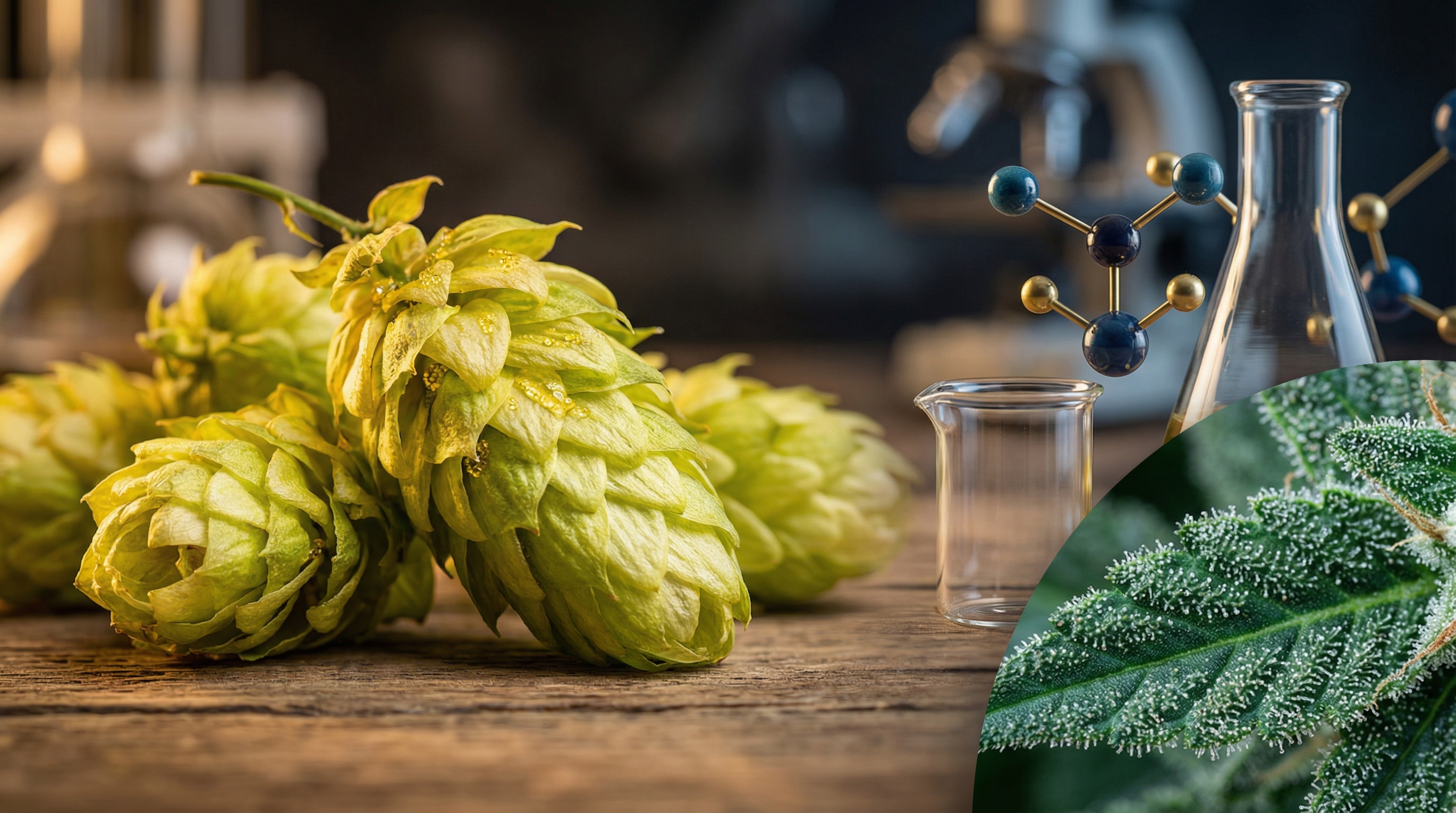
You know that earthy, spicy aroma when you crack open a hoppy IPA? That’s humulene. And it’s the same molecule wafting from your cannabis.
Humulene is named after Humulus lupulus — Latin for hops. It’s one of the most common terpenes in cannabis, though it rarely takes the lead. It plays a supporting role, often appearing with its cousin beta-caryophyllene. Together they create that warm, herbal, woody note in strains like GSC, Headband, and White Widow.
But humulene does far more than add aroma. Studies show it fights swelling as well as prescription steroids. It kills cancer cells in the lab. And unlike most cannabis compounds, it may suppress your appetite instead of boosting it.
Let’s explore what makes humulene special — and why researchers say it “deserves more attention.”
What Is Humulene?
Humulene is a sesquiterpene. That means it’s a bigger molecule than common terpenes like limonene or pinene. It shares its chemical formula with beta-caryophyllene but has a different shape. That’s why these two terpenes almost always show up together. Scientists used to call humulene “alpha-caryophyllene” because of this link.
Where you’ll find it:
- Hops — up to 35% of hop essential oil
- Cannabis — common but rarely dominant (5-15% of total terpenes)
- Sage — a big part of sage’s herbal scent
- Ginseng — in the root’s essential oil
- Black pepper and cloves — next to its cousin caryophyllene
In cannabis, humulene sits behind myrcene, caryophyllene, or limonene in most strains. But its role in the entourage effect may punch above its weight.
How Humulene Fights Inflammation
As Strong as Steroids?
The strongest evidence for humulene is its anti-inflammatory power. The numbers here are hard to ignore.
A key study in the European Journal of Pharmacology compared humulene to dexamethasone — a strong prescription steroid [Fernandes et al., 2007]. The result? Humulene matched the steroid at reducing swelling in animal tests. It blocked three major inflammation triggers at once: bradykinin, histamine, and prostaglandins.
Why does this matter? Long-term steroid use causes weight gain, bone loss, and a weak immune system. A plant terpene that matches those results could offer a much gentler option.
The NF-kB Switch
How does humulene pull this off? It targets a protein called NF-kB. Think of NF-kB as your body’s inflammation switch. When it turns on, your cells start pumping out inflammatory signals. Humulene turns this switch down.
A 2009 study showed that humulene blocks NF-kB from activating [Rogerio et al., 2009]. In mice with airway swelling, it cut three key signals: IL-5, CCL11, and leukotriene B4. The best part? It worked both as prevention and treatment — before or after the swelling started.
In 2024, researchers tested humulene on human immune cells for the first time [Becker & Holtmann, 2024]. They found it cut IL-6 levels by 60%. IL-6 is a major driver of long-term inflammation. High IL-6 is linked to heart disease, diabetes, and autoimmune problems.

Stomach Protection
Humulene also guards your gut. A 2021 study found that humulene prevented stomach lining damage just as well as omeprazole — a common antacid sold as Prilosec [PMC8150829]. It worked by turning down NF-kB in gut cells, cutting two inflammatory signals: IL-1-beta and IL-6.
If cannabis upsets your stomach, this is worth knowing.
The Appetite Question
Does Humulene Really Curb the Munchies?
This is humulene’s most famous claim — and the most nuanced. Let’s be clear about what we know and what we don’t.
What we know: Labs and doctors report that high-humulene strains reduce appetite rather than boost it. A study from the University of Arizona confirmed that humulene binds to CB1 receptors [LaVigne et al., 2021]. These are the same receptors THC uses to trigger the munchies.
But here’s the twist. THC turns CB1 on full blast. Humulene seems to work differently. The 2021 study showed humulene activated CB1 in the lab but caused pain relief in mice, not hunger. Researchers think humulene may sit on the receptor in a way that partly blocks THC’s appetite signal. Think of it as a dimmer switch on the munchies dial.
What we don’t know: No human study has tested humulene’s appetite effects in isolation. The evidence comes from lab reports, clinical observations, and receptor data.
The practical tip: If you want cannabis without the munchies, look for strains with higher humulene. Pair it with caryophyllene and THCV for the strongest appetite-curbing effect.
Anti-Tumor Research
What the Lab Shows
Cancer research is the hottest area for humulene. A large review found that 41% of all published studies on humulene look at its anti-tumor effects. That makes it the most-studied property of this terpene.
Lab results show humulene kills several cancer cell types:
- Colorectal cancer [Ambroz et al., 2019]
- Liver cancer — by blocking Akt signaling [Chen et al., 2019]
- Breast cancer (MCF-7 cells) [Legault et al., 2003]
- Lung cancer
- Ovarian cancer
- Pancreatic cancer — by blocking NF-kB
How it works: Humulene strips cancer cells of their defenses. It drains an antioxidant called glutathione from inside the cell. Without this shield, harmful oxygen molecules flood the cell and trigger its death.
The caryophyllene boost: Beta-caryophyllene makes humulene work even better against cancer cells. In one breast cancer study, humulene alone stopped 50% of growth. Adding caryophyllene pushed that to 75% [Legault & Pichette, 2007]. Since these two terpenes appear together in cannabis naturally, you get this boost built in.
Important caveat: This is all lab research — cell dishes and animal studies, not human trials. A 2024 review from Imperial College London looked at 340 humulene studies and found almost none had reached human testing [PMC11254484]. The potential is exciting, but the clinical proof isn’t here yet.

Humulene Talks to Your Cannabinoid Receptors
For years, caryophyllene was the only terpene known to directly talk to cannabinoid receptors. New research has changed that.
A 2021 study showed that humulene turns on both CB1 and CB2 receptors plus adenosine A2a receptors [LaVigne et al., 2021]. In mice, it produced cannabinoid-like effects including pain relief. When researchers blocked the cannabinoid receptors, the effects went away. That proves humulene works through the endocannabinoid system.
What does this mean for you? Humulene isn’t just adding a nice smell. It’s talking to the same receptors as THC and CBD. When you use a strain with both humulene and THC, the terpene may be shaping how the high feels. That’s the entourage effect at work.
Why No One Has Made a Humulene Pill (Yet)
The research looks great on paper. But humulene has a long road to the pharmacy shelf. The 2024 Imperial College London review found three big roadblocks:
Your body breaks it down fast. Humulene is fat-soluble and your liver clears it quickly. Getting enough into your blood through pills is hard.
It’s hard to test alone. Most studies use essential oil blends, not pure humulene. So we can’t always tell which effects come from humulene versus other compounds in the mix.
Zero human trials. As of 2024, not one human clinical trial has tested humulene on its own. Zero.
This may be why cannabis is such an effective delivery system. You get humulene alongside cannabinoids and other terpenes that work together naturally.
High Families and Humulene
In our High Spectrum system, humulene fits best in the Relief High family. This makes sense — it’s a strong anti-inflammatory that partners with caryophyllene, the terpene that defines Relief.
Relief High strains tend to have:
- High caryophyllene + humulene levels
- Anti-inflammatory and pain-relieving effects
- Physical comfort without heavy sedation
- Earthy, spicy, herbal aromas
If you want humulene-rich strains, look in the Relief and Relax families.
Where to Find Humulene
High-Humulene Cannabis Strains
Humulene rarely tops the terpene chart, but these strains show higher-than-average levels:
- Girl Scout Cookies (GSC) — sweet and earthy with notable humulene
- Headband — among the highest humulene-to-total-terpene ratios
- White Widow — classic earthy-spicy profile from humulene and caryophyllene
- OG Kush — earthy backbone alongside myrcene
- Skywalker OG — herbal and woody with strong humulene
- Death Star — earthy and pungent with high humulene content
- Pink Kush — sweet and earthy with strong humulene
- Sour Diesel — the diesel-funk profile includes solid humulene
Beyond Cannabis
You can get humulene from everyday foods too:
- Beer — especially IPAs heavy on Chinook, Cascade, or Simcoe hops
- Sage — one of the richest non-cannabis sources
- Ginseng — the classic herbal adaptogen
- Black pepper — alongside its partner caryophyllene
- Cloves — adds that warm, spicy depth
Key Takeaways
Here’s what matters most:
Humulene is the quiet achiever. It doesn’t dominate terpene charts like myrcene. But its resume — anti-inflammatory, appetite-suppressing, anti-tumor, gut-protective — is one of the most impressive in cannabis.
The caryophyllene partnership is key. These molecular siblings almost always appear together. Research shows they boost each other’s effects. If you see one on a lab report, the other is likely there too.
The appetite angle is real but needs more proof. Labs and doctors report appetite suppression with high-humulene strains. CB1 receptor data supports the idea. But we’re still waiting for the definitive human study.
Follow your nose. If your cannabis smells like it could be in a craft beer — earthy, woody, hoppy — humulene is likely playing a big role.
Track your experience with humulene-rich strains in High IQ. Your personal patterns will tell you more than any study ever could.
Sources
- Becker, L. & Holtmann, D. (2024). Anti-inflammatory effects of alpha-humulene on the release of pro-inflammatory cytokines in LPS-induced THP-1 cells. Cell Biochemistry and Biophysics, 82, 839-847. DOI: 10.1007/s12013-024-01235-7
- Fernandes, E.S. et al. (2007). Anti-inflammatory effects of compounds alpha-humulene and (-)-trans-caryophyllene isolated from the essential oil of Cordia verbenacea. European Journal of Pharmacology, 569(3), 228-236.
- Rogerio, A.P. et al. (2009). Preventive and therapeutic anti-inflammatory properties of the sesquiterpene alpha-humulene in experimental airways allergic inflammation. British Journal of Pharmacology, 158(4), 1074-1087. PMC2785529
- LaVigne, J.E. et al. (2021). Cannabis sativa terpenes are cannabimimetic and selectively enhance cannabinoid activity. Scientific Reports, 11, 8232. PMC8050080
- Chen, H. et al. (2019). Alpha-humulene inhibits hepatocellular carcinoma cell proliferation and induces apoptosis through the inhibition of Akt signaling. Food and Chemical Toxicology, 134, 110830. PubMed: 31562948
- Legault, J. & Pichette, A. (2007). Potentiating effect of beta-caryophyllene on anticancer activity of alpha-humulene, isocaryophyllene and paclitaxel. Journal of Pharmacy and Pharmacology, 59(12), 1643-1647.
- Ambroz, M. et al. (2019). Sesquiterpenes alpha-humulene and beta-caryophyllene oxide enhance the efficacy of 5-fluorouracil and oxaliplatin in colon cancer cells. Acta Pharmaceutica, 69, 121-128.
- Imperial College London (2024). The Clinical Translation of alpha-humulene: A Scoping Review. Planta Medica. PMC11254484
- Jang, H.I. et al. (2021). Humulene Inhibits Acute Gastric Mucosal Injury by Enhancing Mucosal Integrity. Frontiers in Pharmacology. PMC8150829