

Linalool: The Lavender Terpene for Calm and Better Sleep
Discover how linalool creates calm through NMDA receptors. Science-backed research on anxiety, sleep, and why this floral terpene works differently.

Professor High
The Terpene That Works Like an Anxiolytic
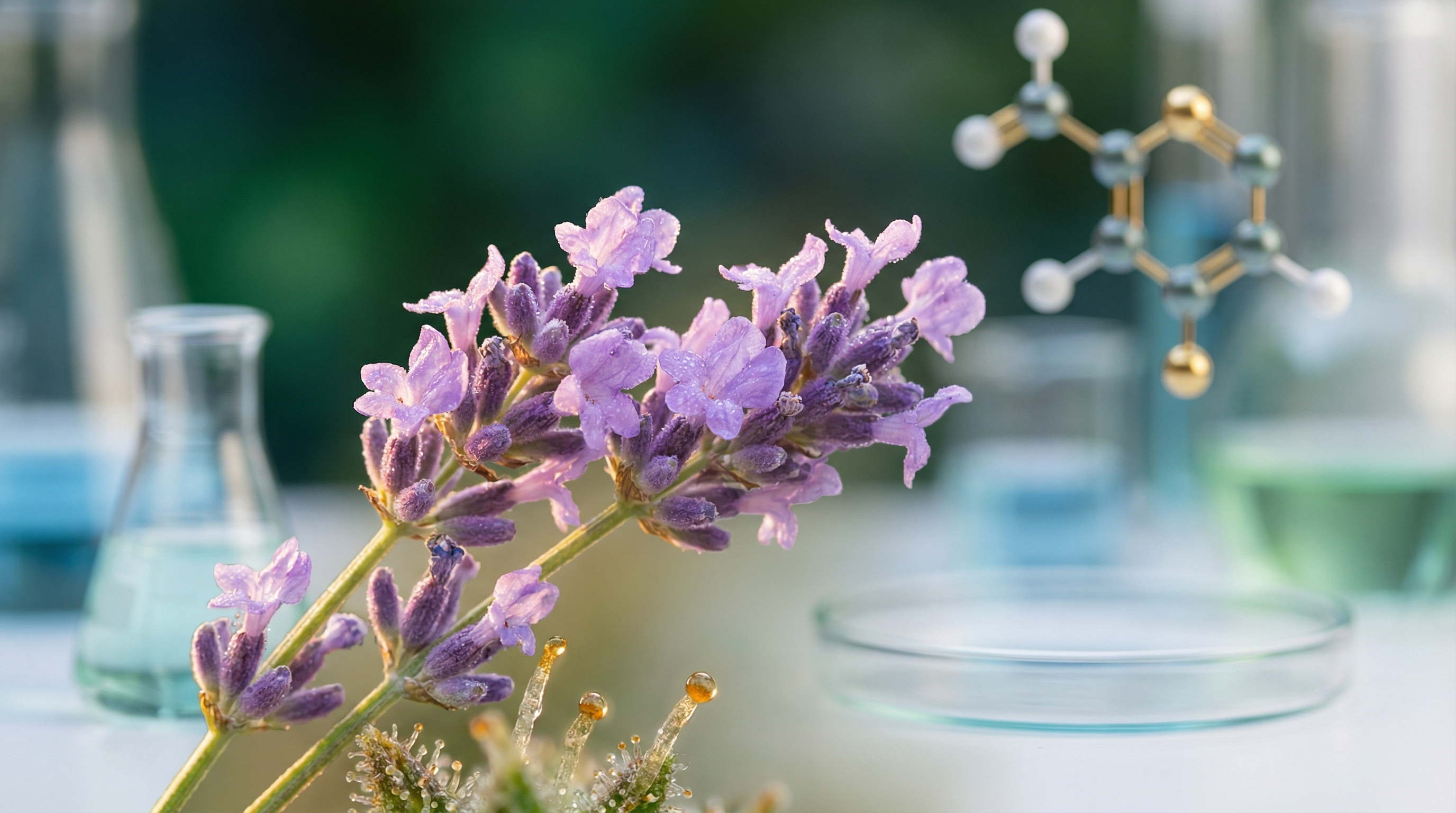
You know that wave of calm that washes over you when you smell fresh lavender? That’s not just placebo. It’s a molecule called linalool doing something remarkable to your brain chemistry.
Linalool is the third or fourth most common terpene in cannabis, responsible for that distinctive floral, slightly spicy scent in strains like Lavender, LA Confidential, and Amnesia Haze. But unlike myrcene, which sedates you through GABA enhancement, linalool works through an entirely different mechanism—one that explains why it calms without necessarily making you sleepy.
In this guide, we’ll explore the unique neuroscience of linalool, including its interaction with NMDA receptors, the 2024 clinical research on anxiety, and why 11 randomized controlled trials confirm what aromatherapists have claimed for centuries.
The Science: NMDA Receptor Modulation
A Different Pathway to Calm
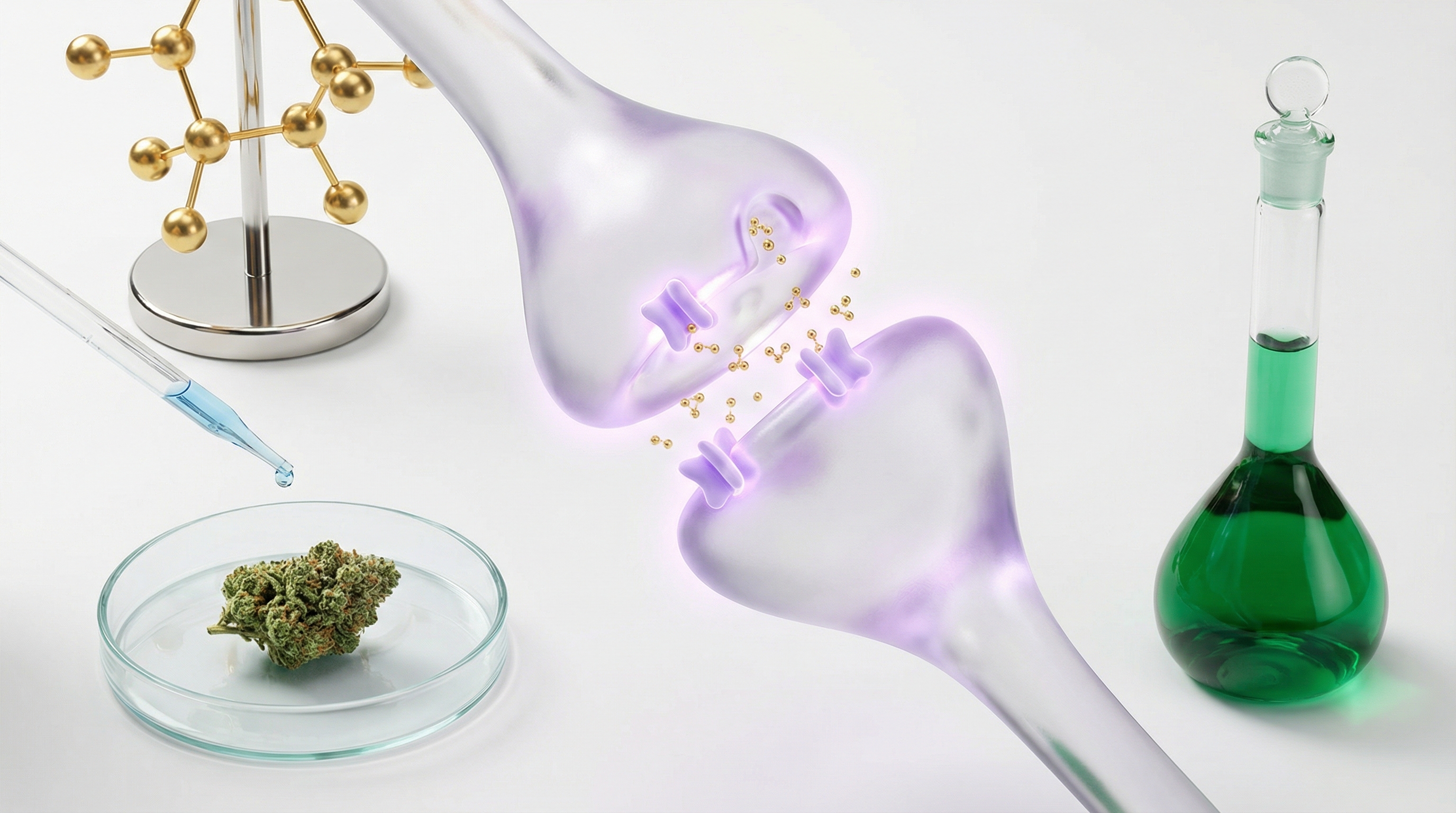
Here’s what makes linalool fascinating: it doesn’t primarily work through GABA like most calming compounds. Instead, linalool targets the glutamate system—specifically, it acts as a non-competitive antagonist of NMDA receptors.
Let’s unpack that.
Glutamate is your brain’s “go” signal. It’s the most abundant excitatory neurotransmitter, responsible for alertness, learning, and neural activation. When glutamate binds to NMDA receptors, your neurons fire more intensely.
Linalool turns down that signal. Research published in Phytotherapy Research found that linalool causes dose-dependent non-competitive inhibition of NMDA receptor binding with an IC50 of 2.97 mM [Elisabetsky et al., 2001]. In practical terms: linalool reduces how strongly NMDA receptors respond to glutamate without completely blocking them.
This is crucial because complete NMDA blockade causes dissociation and hallucinations (that’s how ketamine works). Linalool’s partial modulation creates calm without cognitive distortion.
The glutamate release connection: A study in Neurochemical Research found that linalool also reduces potassium-stimulated glutamate release in brain tissue [Elisabetsky et al., 2001]. Less glutamate released means less neural excitation—another pathway to calm.
Why This Matters for Anxiety
Excessive glutamate signaling is linked to anxiety disorders. When your brain’s excitatory system runs too hot, you feel on edge, hypervigilant, unable to relax. By dampening NMDA receptor activity, linalool addresses anxiety at a fundamental neurochemical level.
A 2019 study in Biomedicine & Pharmacotherapy demonstrated this in action [Dos Santos et al., 2019]. Researchers exposed neuronal cells to NMDA-induced excitotoxicity—essentially, glutamate overload that damages neurons. Linalool treatment:
- Reduced oxidative stress caused by NMDA toxicity
- Preserved mitochondrial function in stressed neurons
- Protected against cell death from glutamate overload
This neuroprotective effect helps explain why linalool doesn’t just mask anxiety symptoms—it addresses the underlying neural hyperexcitability.
The Olfactory Shortcut
Here’s something remarkable: linalool can calm you without entering your bloodstream.
A groundbreaking 2018 study in Frontiers in Behavioral Neuroscience tested this directly [Harada et al., 2018]. Researchers exposed mice to linalool odor and measured anxiolytic effects. The results showed effects comparable to diazepam (Valium)—without motor impairment.
But when they blocked the mice’s sense of smell, the calming effects vanished.
The conclusion: linalool triggers calming signals through your olfactory system, sending relaxation cues directly to your brain’s emotional centers before the molecule even reaches your bloodstream. This explains why simply smelling lavender—or a linalool-rich cannabis strain—can shift your mental state within seconds.
2024 Research: What the Latest Studies Show
Sex Differences in Anxiolytic Effects
A December 2024 study in NeuroSci examined how linalool vapor affects anxiety in mice—and found something unexpected [LaVigne et al., 2024].
Both male and female mice showed anxiolytic effects from inhaled linalool. But the responses differed:
- Female mice showed more pronounced effects at lower doses
- Male mice required higher concentrations for equivalent anxiety reduction
- The vapor delivery (mimicking human inhalation) confirmed effects translate to realistic consumption methods
This is one of the first studies to identify sex-based differences in terpene response. It suggests dosing guidance may eventually need to account for biological sex—something the cannabis industry hasn’t yet addressed.
Human Inhalation Study (October 2024)
A study published in Heliyon tested linalool inhalation directly in 48 human subjects under induced stress conditions [Chen et al., 2024].
Researchers compared three terpenes: linalool, beta-caryophyllene, and citral. While all three showed some anxiolytic potential, the study measured physiological stress markers like cortisol and alpha-amylase.
Linalool inhalation demonstrated anxiolytic effects through the olfactory pathway—confirming that the smell-to-calm connection isn’t just placebo.

The Sleep Evidence: 11+ Randomized Controlled Trials
Linalool’s sleep benefits have been studied more rigorously than almost any other terpene. A 2014 systematic review identified 15 quantitative human studies on inhaled essential oils and sleep, with 11 randomized controlled trials specifically examining hypnotic effects [Lillehei & Halcon, 2014].
Lavender—containing 25-35% linalool—was the most frequently studied essential oil. The majority of studies found positive effects on sleep quality.
Let’s look at specific trials:
Cardiac Patients (2020)
A randomized controlled trial with 90 cardiac patients compared lavender aromatherapy to peppermint and control conditions [Karadag et al., 2020].
After 7 nights of lavender inhalation:
- Sleep quality improved dramatically (PSQI score dropped from 14.8 to 4.8)
- Effects were statistically significant (p < 0.001)
- The magnitude of improvement exceeded the peppermint group
Cancer Patients (2020)
A study of 120 cancer patients tested lavender aromatherapy for 14 days [Seyyed-Rasooli et al., 2020]. The lavender group showed:
- Significant sleep quality improvement vs. control
- Better outcomes than distilled water placebo
- The study specifically attributed effects to linalool and linalyl acetate content
Diabetic Insomnia Patients (2020)
A randomized crossover placebo-controlled trial examined patients with type II diabetes AND insomnia [Afrasiabian et al., 2020].
Inhaled lavender oil demonstrated:
- Significant hypnotic effect (improved sleep quality)
- Improvements in quality of life measures
- Better metabolic control alongside sleep improvements
Post-Surgery Patients (2025)
The most recent study, published in Frontiers in Pharmacology, tested lavender aromatherapy on patients recovering from intracranial tumor surgery [Liu et al., 2025].
GC-MS analysis confirmed the lavender oil contained 27.85% linalool and 34.50% linalyl acetate. Results showed:
- Improved postoperative sleep quality
- Reduced perioperative neurocognitive disorders
- The therapeutic effects were attributed to linalool content
The Systematic Conclusion
Across diverse populations—healthy adults, cardiac patients, cancer patients, diabetic patients, surgical recovery patients—the pattern holds: linalool-rich lavender consistently improves sleep quality in randomized controlled trials.
This isn’t folk medicine. It’s replicated clinical evidence.
Linalool vs. Myrcene: Understanding the Difference
If you’ve read about myrcene, you might wonder: both terpenes are calming, so what’s the difference?
| Factor | Linalool | Myrcene |
|---|---|---|
| Primary mechanism | NMDA receptor modulation | GABA-A enhancement |
| Main effect | Anxiolytic (anti-anxiety) | Sedative (sleep-inducing) |
| Motor impairment | Minimal | Significant at high doses |
| Aroma | Floral, lavender, spicy | Earthy, musky, herbal |
| Best for | Anxiety, stress, functional calm | Deep relaxation, sleep, pain |
| Daytime use | More suitable | Less suitable |
The key distinction: Myrcene makes you sleepy. Linalool makes you calm. They’re related but not identical effects.
Myrcene upregulates GABA receptors—the same system benzodiazepines target. This creates sedation and motor impairment at higher doses. A 2023 driving study showed that 15mg of pure myrcene impaired speed control and divided attention.
Linalool works through glutamate modulation, which reduces anxiety without necessarily inducing drowsiness. The 2018 mouse study showed anxiolytic effects without motor impairment—a crucial difference.
When to Choose Each
Choose linalool-dominant strains when:
- You need to stay functional but calm
- Anxiety is your primary concern
- You want to take the edge off without couch lock
- Social situations feel overwhelming
- You’re dealing with stress during the day
Choose myrcene-dominant strains when:
- Sleep is your primary goal
- Deep physical relaxation is desired
- Evening wind-down is the context
- Pain relief with sedation is helpful
- You can fully surrender to the experience
The combination: Many strains contain both terpenes. Lavender Kush, for example, pairs linalool’s anxiolytic effects with myrcene’s sedation—which may help with nighttime anxiety that prevents sleep.
The Antidepressant Connection
Linalool doesn’t just address anxiety—it also shows antidepressant activity through the monoaminergic pathway.
A study in Life Sciences found that linalool’s antidepressant effects involve:
- Serotonergic system (5-HT1A receptors)
- Adrenergic system (norepinephrine pathways)
These are the same systems targeted by SSRIs and other antidepressants. While linalool won’t replace medication, it may contribute to mood support as part of the entourage effect.
Strains in the Uplift High family often combine linalool with limonene—creating a profile that addresses both anxiety and low mood.

Finding Linalool-Rich Cannabis
Check Lab Results
Look for terpene profiles where linalool appears prominently—typically as the 2nd, 3rd, or 4th most abundant terpene. Concentrations above 0.2% indicate meaningful linalool presence; above 0.5% is notably high.
Follow Your Nose
Linalool has a distinctive floral, lavender-like scent with spicy undertones. If a strain smells like:
- Fresh lavender flowers
- Floral with a hint of spice
- Sweet and slightly citrusy
…linalool is likely present. This contrasts with myrcene’s earthy/musky profile or limonene’s bright citrus notes.
Classic Linalool Strains
- Lavender — The namesake strain, known for floral aromatics
- LA Confidential — Heavy linalool with deep relaxation
- Amnesia Haze — Linalool balanced with energizing terpenes
- Granddaddy Purple — Combines linalool with myrcene
- Kosher Kush — Complex profile with prominent linalool
- Do-Si-Dos — Floral notes from linalool presence
- Zkittlez — Sweet with linalool undertones
The Relax High Family
At This Is Why I’m High, we classify strains by their expected effects based on terpene chemistry. Many linalool-prominent strains fall into the Relax High family—characterized by calming effects without extreme sedation.
If anxiety relief is your primary goal, exploring this family gives you pre-filtered options where linalool plays a meaningful role.
Practical Applications
For Anxiety Management
Based on the research, linalool can help with anxiety through multiple routes:
Inhalation — Simply smelling linalool-rich cannabis (or lavender) triggers olfactory pathways to the amygdala. Effects begin within seconds.
Vaporization — Delivers linalool directly to your lungs and bloodstream. The 2024 human study confirmed anxiolytic effects through inhalation.
Combination with CBD — CBD also modulates glutamate signaling. Pairing CBD-rich strains with linalool content may create synergistic anxiety relief.
For Sleep Support
While linalool isn’t primarily sedating, it supports sleep by:
- Reducing the anxiety that keeps you awake
- Promoting parasympathetic (rest-and-digest) activity
- Lowering physiological stress markers
The 11+ RCTs used lavender aromatherapy for 20-60 minutes before sleep. For cannabis, consuming a linalool-rich strain 1-2 hours before bed allows time for effects to develop.
Dosing Considerations
Unlike myrcene, which showed clear dose-dependent impairment, linalool appears to have a wider therapeutic window. The 2018 study showed anxiolytic effects without motor impairment—suggesting you can benefit from linalool while remaining functional.
That said, cannabis contains multiple compounds. A strain high in both linalool AND myrcene will still produce sedation from the myrcene content. Check the full terpene profile, not just linalool levels.
The Entourage Effect: Linalool’s Role
Linalool works synergistically with other cannabis compounds:
With THC: Linalool may moderate THC’s anxiety-inducing potential. The 2024 limonene study showed terpenes can reduce THC-related paranoia; linalool likely contributes similarly through glutamate modulation.
With CBD: Both compounds affect glutamate signaling. The combination may be particularly effective for anxiety without intoxication.
With myrcene: The calming + sedating combination is powerful for nighttime use. Strains like Granddaddy Purple leverage both.
With limonene: Linalool’s calm + limonene’s mood lift creates an anxiolytic-but-functional profile. Good for daytime stress relief.
Understanding these patterns is part of the entourage effect—why whole-plant cannabis often works better than isolated compounds.
Key Takeaways
Linalool works differently than you’d expect. It’s not primarily a GABA enhancer like myrcene. Instead, it modulates NMDA receptors and glutamate signaling—creating calm without heavy sedation.
The olfactory pathway is real. Simply smelling linalool triggers anxiety reduction through direct brain signaling. You don’t need to consume it for benefits.
Clinical evidence is strong. 11+ randomized controlled trials confirm lavender’s (linalool’s) positive effects on sleep and anxiety. This isn’t folk medicine—it’s replicated research.
Sex differences exist. The 2024 study found females respond more strongly at lower doses. This may eventually inform personalized dosing.
Linalool complements myrcene. If you want calm without couch lock, prioritize linalool. If you want deep sedation, prioritize myrcene. Many strains offer both.
Functional calm is possible. Unlike myrcene, which impaired driving performance, linalool shows anxiolytic effects without motor impairment. It’s more suitable for daytime use when stress relief matters.
Sources
Elisabetsky, E., et al. (2001). “Effects of Linalool on [3H] MK801 and [3H] Muscimol Binding in Mouse Cortical Membranes.” Phytotherapy Research, 15(5), 422-425.
Elisabetsky, E., et al. (2001). “Effects of Linalool on Glutamate Release and Uptake in Mouse Cortical Synaptosomes.” Neurochemical Research, 26(3), 191-194.
Harada, H., et al. (2018). “Linalool Odor-Induced Anxiolytic Effects in Mice.” Frontiers in Behavioral Neuroscience, 12, 241.
Dos Santos, E.R.Q., et al. (2019). “Linalool attenuates oxidative stress and mitochondrial dysfunction mediated by glutamate and NMDA toxicity.” Biomedicine & Pharmacotherapy, 118, 109295.
LaVigne, J.E., et al. (2024). “Sex Differences in the Anxiolytic Properties of Common Cannabis Terpenes, Linalool and β-Myrcene, in Mice.” NeuroSci, 5(4), 45.
Chen, X., et al. (2024). “Exploring the physiological response differences of β-caryophyllene, linalool and citral inhalation and their anxiolytic potential.” Heliyon, 10(20), e39472.
Lillehei, A.S. & Halcon, L.L. (2014). “A Systematic Review of the Effect of Inhaled Essential Oils on Sleep.” Journal of Alternative and Complementary Medicine, 20(6), 441-451.
Karadag, E., et al. (2020). “Comparing the effect of aromatherapy with peppermint and lavender on the sleep quality of cardiac patients.” Sleep Science and Practice, 4, 9.
Afrasiabian, F., et al. (2020). “Efficacy of inhaled Lavandula angustifolia Mill. Essential oil on sleep quality, quality of life and metabolic control in patients with diabetes mellitus type II and insomnia.” Journal of Ethnopharmacology, 251, 112560.
Liu, Y., et al. (2025). “Effects of lavender essential oil inhalation aromatherapy on postoperative sleep quality in patients with intracranial tumors.” Frontiers in Pharmacology, 16, 1584998.
Guzmán-Gutiérrez, S.L., et al. (2015). “Linalool and β-pinene exert their antidepressant-like activity through the monoaminergic pathway.” Life Sciences, 128, 24-29.
Malcolm, B.J. & Tallian, K. (2017). “Essential oil of lavender in anxiety disorders: Ready for prime time?” Mental Health Clinician, 7(4), 147-155.