Scientific illustration for Combination of red and UV-A light enhances hemp (Cannabis sativa L.) inflorescence yield and cannabinoid content.

Combination of red and UV-A light enhances hemp (Cannabis sativa L.) inflorescence yield and cannabinoid content.

Scientific reports β€’ β€’ Highly Relevant
πŸ€–

AI Summary

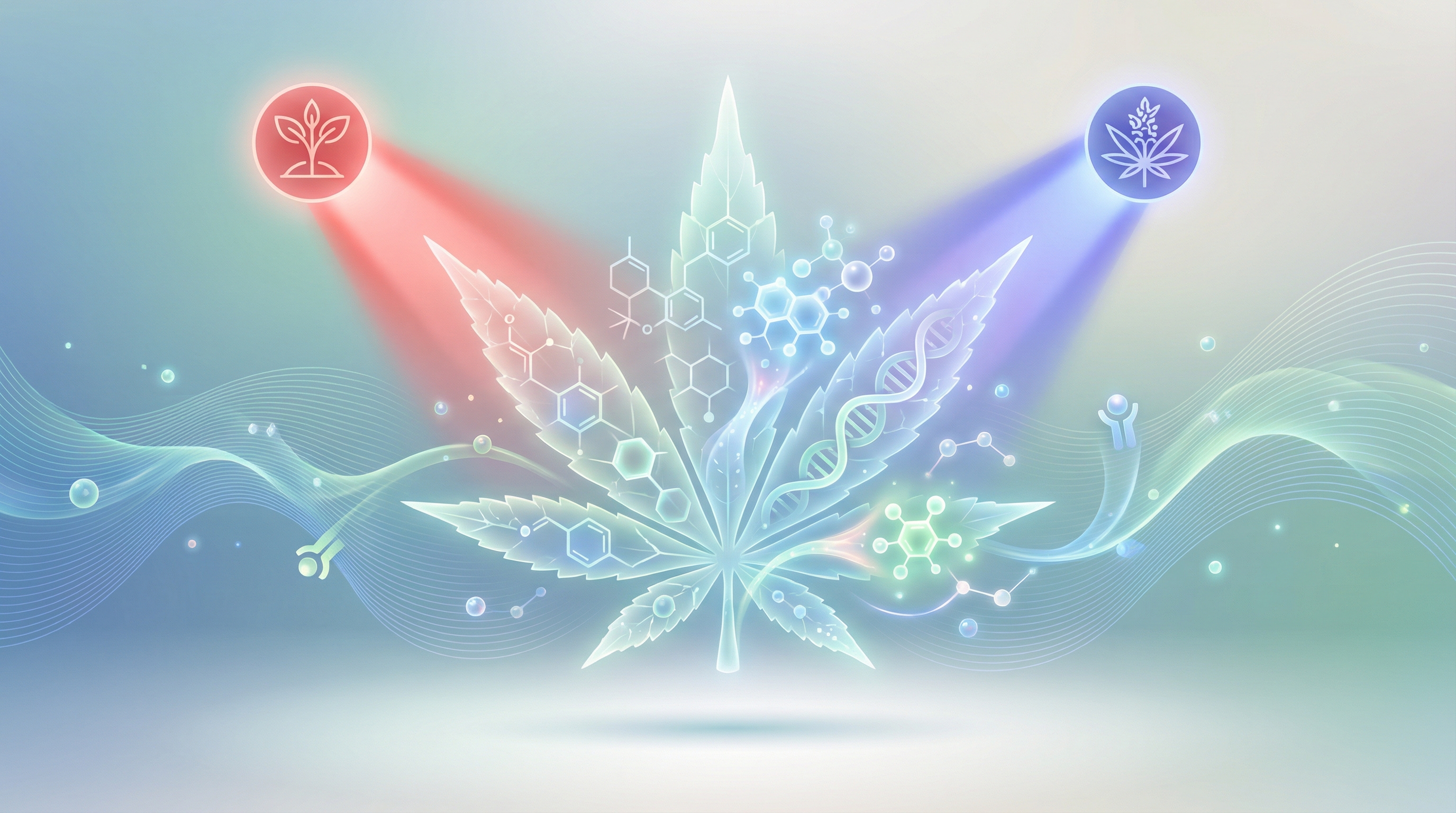
Researchers at this study investigated how different light wavelengths affect hemp plant growth and cannabinoid productionβ€”the compounds that make hemp and cannabis valuable. Using a high-CBD hemp strain grown indoors, they tested four lighting scenarios: standard white light (control), white light plus extra red light during the growing phase, white light plus UV-A light during flowering, and a combination of both red and UV-A light at their respective growth stages. This approach is practical for commercial growers who want to maximize yields without changing their basic growing setup.

The results showed that adding red light during the vegetative (early growth) stage produced plants with more branches and increased overall flower yield by about 18%. Adding UV-A light during the flowering stage was especially effective at boosting cannabinoid production, increasing CBG (cannabigerol) by 53% and CBD (cannabidiol) by 12%. When growers combined both strategiesβ€”red light in early growth and UV-A light during floweringβ€”they achieved the most dramatic results, with CBG yields nearly doubling and CBD yields jumping by 44% compared to standard white light alone.

Interestingly, while the combined approach (red + UV-A) produced more total CBD per plant than any other treatment, the increases in CBD weren't significantly larger than using UV-A light alone, suggesting there may be limits to how much cannabinoid production can be enhanced through light manipulation. These findings have important practical implications for indoor hemp and cannabis growers: strategic use of specific light wavelengths at different growth stages can substantially improve both plant structure and cannabinoid content, potentially allowing producers to increase their yields without major equipment investments or changes to their growing environment.

πŸ’‘ Key Findings

1
Combined red light (vegetative stage) and UV-A light (flowering stage) supplementation increased CBD yield by 44.1% and CBG yield by 91.8% compared to standard white light control, achieving 4.62g CBD and 0.53g CBG per plant
High
95%
2
Red light supplementation during vegetative stage increased the number of effective branches by 18% and inflorescence (flower) yield by 17.9%, demonstrating that specific light wavelengths optimize plant structure
High
95%
3
UV-A light supplementation during flowering stage increased CBG content by 52.7% and CBD content by 12.1%, showing UV-A's particular effectiveness for cannabinoid synthesis stimulation
High
95%
4
Combined red and UV-A supplementation showed no additive effect on CBD yield specificallyβ€”CBD yields were not significantly higher than UV-A aloneβ€”suggesting potential physiological limits to cannabinoid enhancement through light manipulation
High
90%
5
Stage-specific light spectrum optimization is a practical approach for indoor hemp cultivation that can substantially improve both biomass accumulation and phytochemical yield without requiring major cultivation system changes
High
90%

πŸ“„ Original Abstract

Light spectrum plays a crucial role in regulating the growth of hemp (Cannabis sativa L.) plants and the biosynthesis of secondary metabolites. Several studies have demonstrated that additional red-light exposure increases biomass accumulation, while supplementary UV-A light stimulates cannabinoid synthesis. Nevertheless, the potential of stage-specific supplementation of red and UV-A light remains underexplored in its capacity to optimize cannabinoid yield in indoor hemp cultivation. In the present study, the effect of red light in combination with UV-A light on hemp biomass and cannabinoid accumulation was investigated using a high-CBD strain. There were four treatments: (1) white light throughout the growth period (control; VWRW); (2) red light supplementation during the vegetative stage (VWRRW); (3) UV-A supplementation (VWRWUV) during the flowering stage; and (4) combined red and UV-A supplementation (VWRRWUV) during the vegetative and flowering stages. Results showed that VWRRW promoted the number of effective branches (increased by 18.0%) compared to the control (VWRW), resulting in an increase in inflorescence yield by 17.9%. VWRWUV increased CBG and CBD content by 52.7% and 12.1%, respectively, relative to the control. The effect of VWRRWUV on biomass and cannabinoid accumulation was the strongest among the treatments, with CBG and CBD yields reaching 0.53&#xa0;g and 4.62&#xa0;g per plant, representing significant increase of 91.8% (p&#x2009;<&#x2009;0.01) and 44.1% (p&#x2009;<&#x2009;0.01), respectively, compared to the control. However, there were no significant differences in CBD yield among the VWRRW, VWRWUV and VWRRWUV treatments, indicating that the combined supplementation of red and UV-A light did not have an additive effect on CBD accumulation. These findings highlight the potential of stage-specific spectral strategy to optimize both plant growth and phytochemical quantity.

Explore More Research

Stay informed about the latest cannabis science.

Track your cannabis journey with AI

Get personalized strain recommendations based on your preferences